At a glance
- 49.54 m
- Height of the arch above Place Charles de Gaulle, the square the avenues share
- 284 steps
- Climbed to reach the terrace; a lift exists for visitors who need it, when in service
- 1923
- Year the flame at the Tomb of the Unknown Soldier was first lit; veterans rekindle it every evening
- 12 avenues
- Radiate from the arch, a pattern best seen from the terrace itself
The climb, landing by landing
For most visitors there is one way up: a spiral stair inside the arch. Here is what each stage of it involves.
Allow five to twenty minutes for the climb depending on your pace; the operator advises taking your time on the stairs and staying hydrated.
- 01 Underpass
Reaching the island
Place Charles de Gaulle is a traffic circle; the arch sits on a central island reached through the Passage du Souvenir, an underground passage from the top of the Champs-Élysées or the Avenue de la Grande-Armée. Crossing the roundabout at street level is not an option.
- 02 The base
At the foot of the arch
The underpass brings you up at the foot of the arch, beside the Tomb of the Unknown Soldier and its flame beneath the great vault. The stair to the top starts inside the monument.
- 03 The reliefs
Passing the four carvings
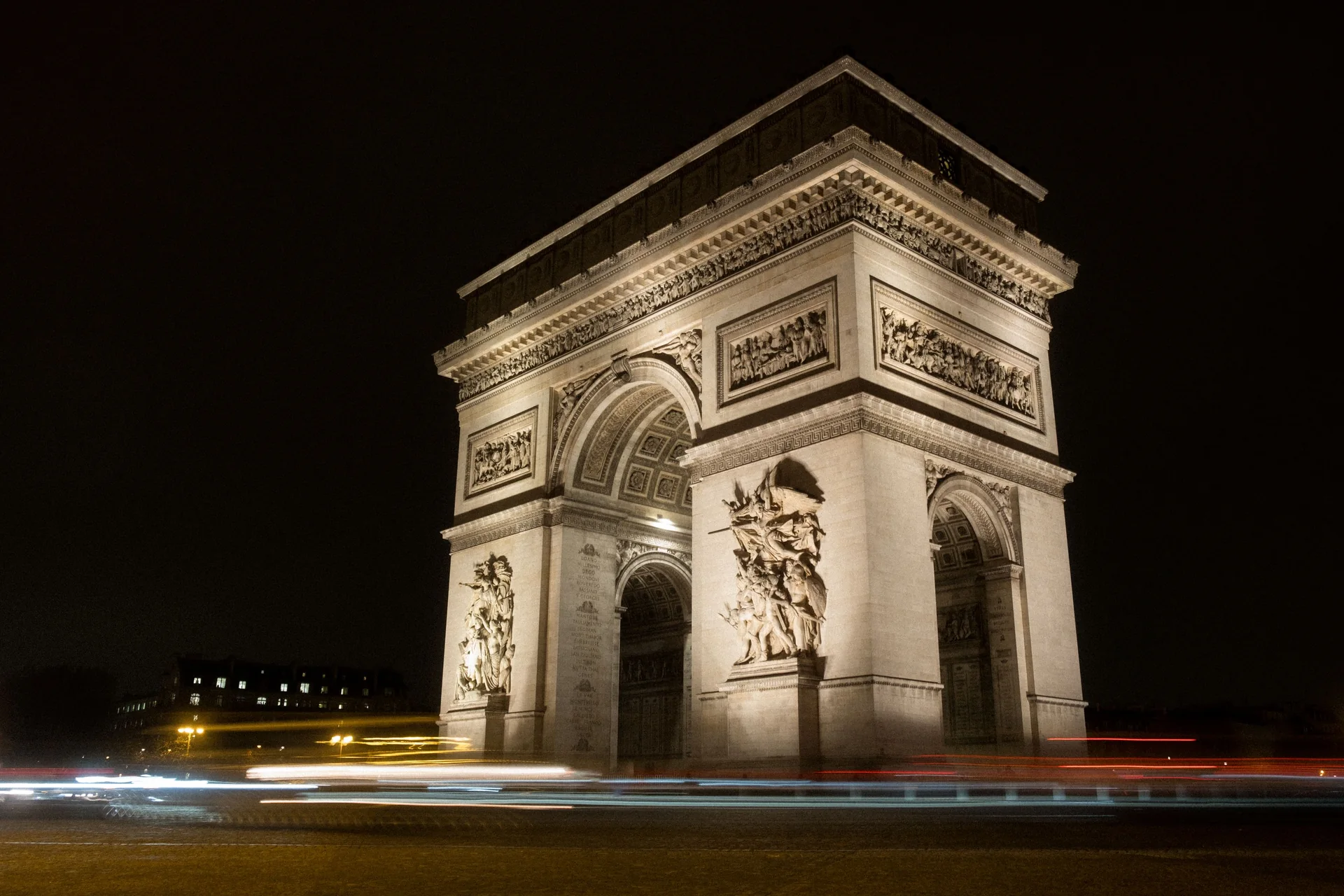
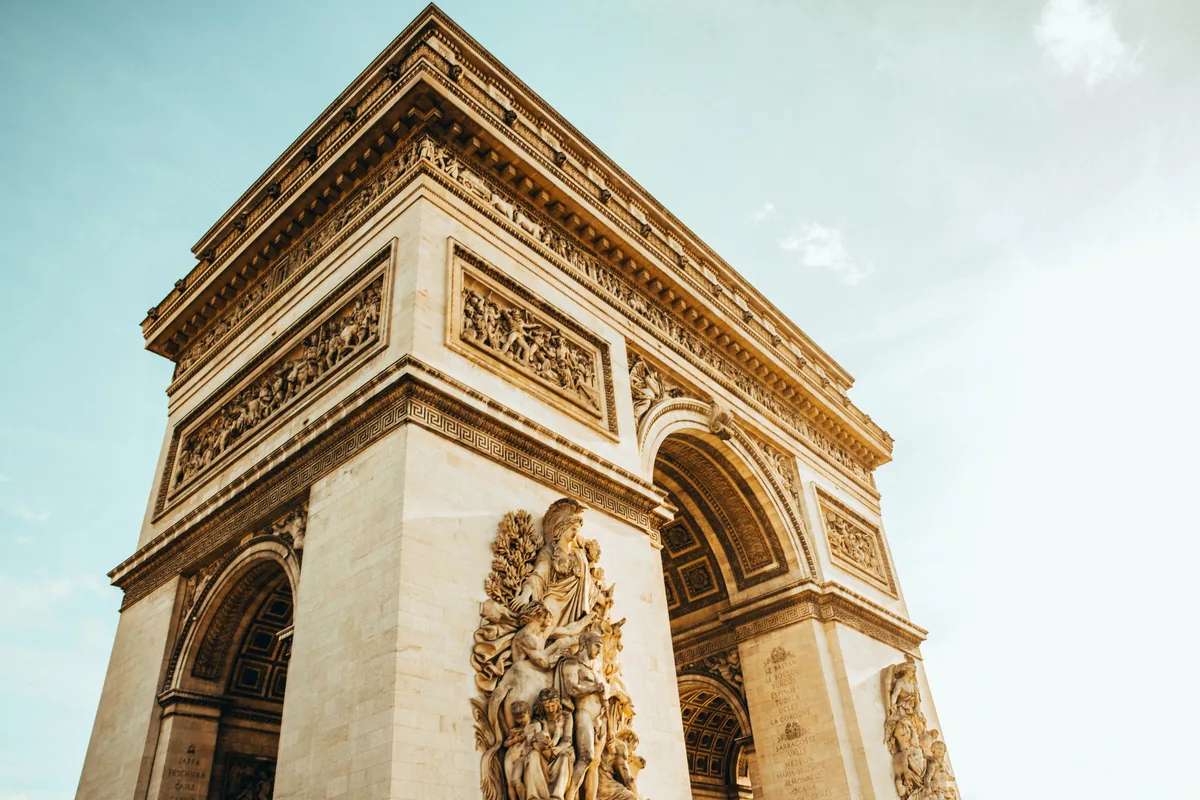
The pillars carry four large sculpted groups: François Rude's Departure of the Volunteers of 1792, known as La Marseillaise, Jean-Pierre Cortot's Triumph of 1810, and Antoine Étex's Resistance of 1814 and Peace of 1815. Look at them from ground level before you climb; the stair is inside the stone.
- 04 The attic museum
A pause near the top
About 240 steps of spiral stair bring you to the attic level, where a small museum hall tells the monument's history with models and multimedia displays.
- 05 The terrace
The roof itself
Roughly 40 more steps bring you out onto the open terrace, 49.54 metres up, with the Champs-Élysées running east towards the Louvre and the Avenue de la Grande-Armée running west towards La Défense.
Why the arch sits where it does
An order Napoleon never saw finished
Napoleon commissioned the arch in 1806 after the victory at Austerlitz, at the Place de l'Étoile on the western edge of Paris. Architect Jean-François Chalgrin took Rome's Arch of Titus as his inspiration, on a far larger scale. Work stalled with Napoleon's fall and was halted under the Bourbon Restoration until 1823; the arch was finished under Louis-Philippe and inaugurated on 29 July 1836, thirty years after it was ordered.
A soldier with no name
On 11 November 1920 the coffin of an unidentified French soldier of the First World War was brought beneath the arch; he was buried there on 28 January 1921 as the Tomb of the Unknown Soldier, honouring the war dead as a whole rather than one man. On 11 November 1923 André Maginot, then minister of war, lit the flame above the tomb for the first time, and veterans' associations have rekindled it every evening since.
The star the arch gives its name
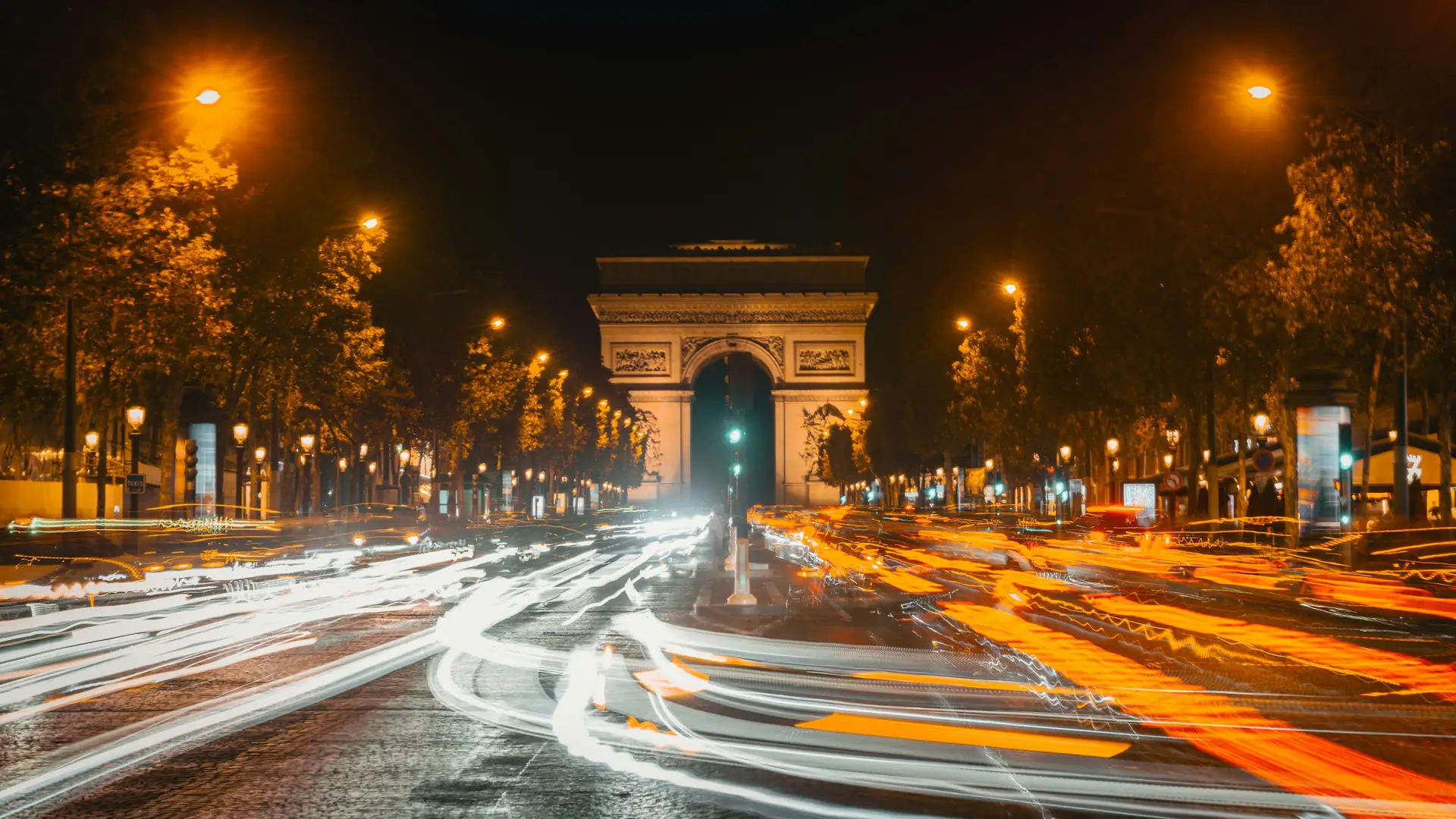
Place Charles de Gaulle was long called Place de l'Étoile — the star. A star-shaped junction existed here before the arch, but the twelve avenues that radiate from it today were laid out under Napoleon III as part of Haussmann's renovation of Paris. Two of them, the Champs-Élysées and the Avenue de la Grande-Armée, run on the straight line known as the axe historique, which continues west to the Grande Arche at La Défense.
Still the stage for national moments
Napoleon's remains passed beneath the arch in 1840 on their return to Paris; Victor Hugo's body lay in vigil beneath it on the night of 31 May 1885; Charles de Gaulle led the Liberation procession from here down the Champs-Élysées on 26 August 1944; and the arch is still the starting point of the annual 14 July military parade. In 2021 it was wrapped in silver-blue fabric, realising a project Christo and Jeanne-Claude had planned since the early 1960s.
Guides to the climb
The best time to visit the Arc de Triomphe
Crowds, light and the handful of days the arch closes — what changes the climb depending on when you go.
Read the guide → 14 JulyThe Arc de Triomphe on Bastille Day
France's national day starts at the arch and runs down the Champs-Élysées — what happens, and what it means for a visit.
Read the guide → Getting up thereHow to reach the Arc de Triomphe rooftop
284 steps, a lift for those who need it and a museum hall near the top — what the climb involves before you book anything.
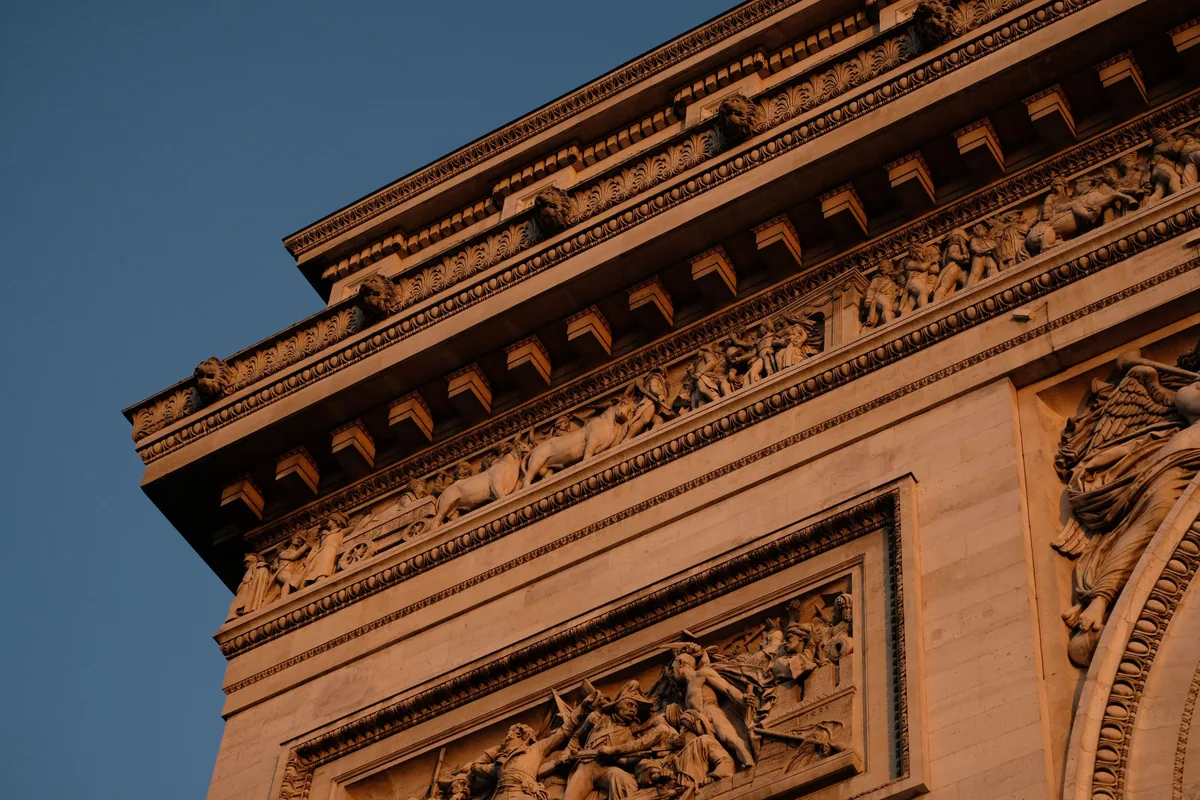
Read the guide → PhotographyPhotographing the Arc de Triomphe
From the terrace, from the avenue, and from the sculptures at ground level — where the angles work, and when.
Read the guide → With childrenVisiting the Arc de Triomphe with kids
The flame, the underground passage and 284 steps — what holds a child's attention, and where the climb gets hard for younger legs.
Read the guide → Every eveningThe eternal flame ceremony at the Arc de Triomphe
A flame first lit in 1923 and rekindled every evening at 18:30 beneath the arch — what happens, and where to stand to see it.
Read the guide → SunsetThe Arc de Triomphe at sunset and blue hour
The terrace sits on the city's historic axis at dusk — when to be up there, and what the light does.
Read the guide → HistoryA short history of the Arc de Triomphe
Ordered by Napoleon in 1806, finished thirty years later, and a stage for French public life ever since.
Read the guide →Questions readers ask
Is this website run by the Arc de Triomphe or its operator?
No. The monument is run by the Centre des monuments nationaux, and this guide has no connection with it; it is written independently and does not sell admission. Tours linked from here are booked through Viator's own checkout.
How many steps are there to the top of the Arc de Triomphe?
284, according to the monument's operator: about 240 on the spiral stair to the museum level, then roughly 40 more to the terrace. A lift serves the museum hall and the terrace for visitors who need it, with no booking required — but the operator currently reports it out of service for maintenance until further notice, so check before relying on it.
What is the Tomb of the Unknown Soldier?
An unidentified French soldier from the First World War, brought beneath the arch on 11 November 1920 and buried there on 28 January 1921, to stand for all the war's unidentified dead. A flame above the tomb was first lit on 11 November 1923 and is rekindled every evening.
What time is the eternal flame ceremony?
Every evening at 18:30. One of the veterans' associations rekindles the flame in a short ceremony; access to the Tomb of the Unknown Soldier is free, so you can watch from beneath the arch without a ticket.
Can I visit the Arc de Triomphe on Bastille Day?
The operator lists 14 July among its annual closure days, because the Bastille Day military parade starts at the arch and runs down the Champs-Élysées. Plan the climb for another day, and check the operator's site for the year's details.
How do I get to the Arc de Triomphe?
By Métro lines 1, 2 or 6 or RER A to Charles de Gaulle–Étoile, then through the Passage du Souvenir, the underground passage from the top of the Champs-Élysées or the Avenue de la Grande-Armée. The roundabout around the arch carries heavy traffic and isn't meant to be crossed on foot.
Is the Arc de Triomphe free for under-18s?
Yes. The operator states free entry for under-18s, and for 18-to-25-year-olds who are EU nationals or non-EU legal residents of France — worth checking directly if that applies to your group.
Why are there twelve avenues at the Arc de Triomphe?
The arch sits on Place Charles de Gaulle, long known as Place de l'Étoile for its star shape. A smaller star of roads existed before the arch was built; the twelve avenues that meet there now were laid out under Napoleon III in Haussmann's renovation of Paris.
Current hours, admission and any closures are set by the operator — see Centre des monuments nationaux's own site.
Tours and rooftop entry on Viator
An independent guide to the climb, the flame and the twelve avenues below
Check tours on Viator